Technical support is supposed to be a straightforward process: You come with a problem, and then you get out with a solution. But if you ever contacted the support hotline for the manufacturer of one of your devices, you’d know how frustrating the process can be. It can take hours, days, or even weeks to solve everything. Aside from that, you have to deal with operators who don’t seem to be as well-versed in the product’s function as you’d like them to be. Bringing your device in for service isn’t any easier. There are still many caveats that can make your experience unpleasant. We will now discuss all of the things you should do to avoid getting stuck in support limbo.
1: Take a Deep Breath!
Each time you need your device serviced, you go through a journey that will not only spend lots of your time, but it will also try your patience. Do not let this get to you. Instead, do something relaxing and try to fret as little as possible about the problem you’re having. Take five and then get in contact with support services. Operators and service personnel get a huge share of irate customers. They’ll be extra nice to you if you are one of the few who are patient, understanding, and fun to work with.
2: Do The Basic Routine

Power down your device, power it back up, check it for infections (if that’s available), check the charger/power chord, check whether there are loose cables anywhere you feel comfortable reaching (in the case of desktop PCs). One time, I had problems talking to someone over my VoIP application. The person on the other end couldn’t hear me. It turned out that I plugged my headphone’s speakers into my microphone jack. This happens to the best of us, so just check everything out, even if you “know” it’s all fine.
3: Do a Little Homework
Now that you’re relaxed, start crunching through Google. Don’t contact anyone just yet. Just browse around to see if you can find a solution to your problem that you can clearly understand. Who knows? Maybe we have it here (type your search term followed by “site:maketecheasier.com”).
So, let’s say that your phone is buggy when deleting widgets. Your search term should be something like “[phone model #] can’t delete widget” or something along these lines. You’ll likely find forum posts with a couple of other users who had the same problem, and perhaps a few proposed solutions that an operator or engineer wouldn’t think of telling you. If you’re not sure of whether a solution is safe to use or not, leave it alone.
4: Determine What’s Wrong
Ask any call center employee how many times he/she receives a call from someone saying something vague like “there’s something wrong with my device.” This is something you want to avoid. First of all, the next thing that’s sure to follow is, “What’s wrong?” That’s just wasteful. Get an idea of what exactly is wrong. Your device doesn’t turn on? Is there anything you do to it that makes it at least function? Does your battery drain quickly? Have you tried running less stuff on it and see if battery life improves?
Do a support session with yourself, asking yourself all of these questions. It’s the only way to truly determine whether you have a strong grasp on what kind of problem you’re running into. Eventually, you’ll end up with something like this: “Hi, my device is not turning on unless I spin around twice and press the power button three times.” That’s more specific than “Hey, my device isn’t turning on.”
5: Dealing With Support

When dealing with a support line, you’ll probably notice that they take you through some routine processes. They may sound a bit annoying, especially if you already did these things yourself to diagnose your problem. For example, every time I call my internet company, they always have me open the command prompt and ping my gateway. That’s always the first thing I do when the internet is down, so the redundancy just gets annoying. But how does the person on the other end of the line actually know I did these things correctly? I just do whatever the operator tells me to and shrug it off. It’s how they know what they’re working with.
6: Dealing With Service Personnel
The “service guy” has two jobs:
- Get the device serviced.
- Make sure you’re not hiding anything.
Those things considered, you should be completely honest about what happened to your device. Do not say “it just went poof, just like that” unless it actually did. If you spilled water on it, say you spilled water on it. Don’t beat around the bush. It spares you the embarrassment of later finding out that they knew you were lying (and, trust me, they’ll know). IT people are much harder to deal with when you lose their trust. They also sometimes take advantage of their superior position over you to make you jump through hoops to get your device fixed.
7: Keep Records of Everything That Happens

Whether you’re calling someone, sending over your device to be serviced, or asking for help over a forum (like Tech Support Guy or Tom’s Hardware Forum), it’s always good to have pictures, screenshots, and notepad documents of everything that goes wrong, including errors, warnings, and notifications.
When asked for more information from someone, you’ll be able to provide it. This is crucial to eventually solving an issue that may be complex, even if it appears simple to the untrained eye.
8: (On Forums) Get Deep Into Detail And Stay Organized
When posting a topic on a tech help forum (like the ones listed above), don’t forget that these people have no clue what your computer looks or behaves like. The only way to accurately convey this is to give as much information as you can about what hardware you run. This includes the type of graphics card, sound card, chipset, motherboard, CPU, and everything else under the sun you can think of that would help give other forum participants an idea of what you’re doing. While you’re at it, be sure to stay organized. Start by briefly describing your problem, then go into more detail, post your specs, then ask whether more information would be needed to solve the problem. A good example would be something like this:
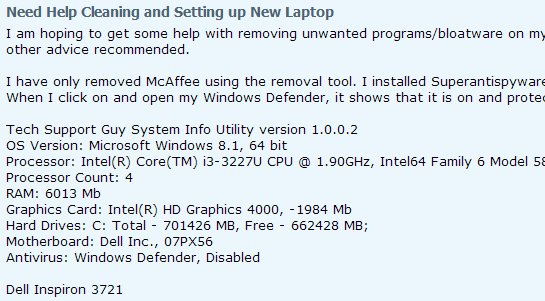
I cropped the image since you don’t really need to see the brunt of the text. Just look at how it’s organized. This particular user did not ask if any more information is needed. Why is that wrong?
You see, upon asking whether other users need more information from you, you send a signal to them that would remind them to ask. Some of these users are night dwellers, meaning they’re very tired and might need a friendly reminder that they can ask for something they don’t have.
Got Any Tips of Your Own?
If you feel that this list is incomplete, help us complete it by commenting below!